Without Delivering Measurable Business Impact, “AI” Is Just 2 Vowels…
Across private equity firms, home offices, private credit firms, and their portfolio companies, AI has rapidly moved from novelty to necessity. But as adoption accelerates, a hard truth is emerging: “AI” is merely two letters unless it delivers measurable business impact.
Over the past few years, AI pilots, POCs, and sandbox experiments have played an important role. They helped organizations build familiarity, reduce fear, and explore use cases. Yet for LPs, boards, and investment committees, this no longer cuts it. What matters now is whether AI solutions are systematically implemented to drive revenue growth, margin expansion, and ultimately enterprise value.
Buyers are increasingly discounting businesses that cannot prove AI-driven operational improvements at exit.
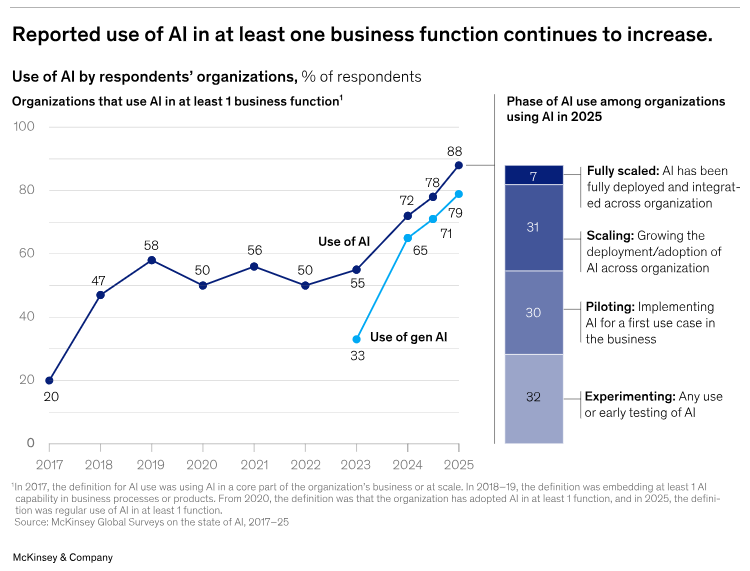
McKinsey’s latest global AI research underscores the problem. While nearly 90% of organizations report using AI in at least one business function, only about one-third have successfully scaled AI initiatives to deliver material financial impact. The majority remain stuck in pilot mode — testing tools without embedding them deeply enough to change how the business actually operates. McKinsey’s findings are clear: the companies capturing real value are those that integrate AI directly into core workflows and performance metrics rather than treating it as an experiment or side project.
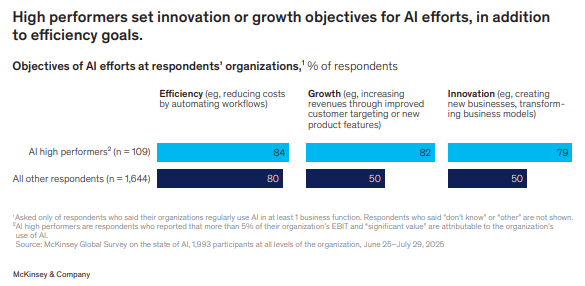
Deloitte’s research reinforces this gap between activity and outcomes. Its AI ROI studies show that fewer than one in five organizations generate returns exceeding 30% on their AI investments. Interestingly, the differentiator is not technology sophistication — it is execution discipline. High performing companies link AI initiatives to specific financial KPIs, redesign processes around them, and hold leadership accountable for results rather than experimentation alone.
Nowhere is this shift more visible than in private capital markets. According to West Monroe’s Future of Private Equity: 2026 Outlook, LPs are no longer impressed by AI roadmaps or slideware. They are actively scrutinizing which deals were sourced with AI, how diligence timelines were reduced, and how portfolio performance measurably improved as a result. The data is explicit: by mid-2026, firms that remain reliant on scattered AI pilots will lag materially behind peers that institutionalize AI as a core capability.
For portfolio companies, the implications are even sharper. Buyers are increasingly discounting businesses that cannot prove AI-driven operational improvements at exit. In a market where revenue growth now accounts for the majority of value creation, AI initiatives that do not translate into faster growth, improved capacity, or defensible margins simply do not move valuation multiples.
By mid-2026, firms that remain reliant on scattered AI pilots will lag materially behind peers that institutionalize AI as a core capability.
This is why 2026 is shaping up to be a table-stakes year for measurable impact AI solutions. The expectation is no longer “Are you experimenting with AI?” but rather “Can you prove what AI has delivered?” Firms that win will treat AI like capital — deploying it intentionally, measuring its return rigorously, and scaling what works. Those that do not will find that enthusiasm without evidence is no longer rewarded.
In the end, AI’s promise is not intelligence — it is impact. And without measurable outcomes, the letters themselves mean very little.
NorthShift’s A(i)scent Platform delivers exactly that measurable impact and increased enterprise value. Click here to learn more.
Recent Posts

Is The AI Analyzing Your Deals Also Exposing Them?
An examination of how AI-powered deal and portfolio tools handle confidential data during normal operation — and why the architecture of those…
The Invisible Data Problem
An examination of how the intelligence and analytics tools widely deployed across private equity portfolios handle confidential company data — and why…
MP/GP Warning: Your LPs Don’t Care That You “Have AI.” They Care What It Changed.
LPs and boards are done funding “AI ambition.” They’re asking for proof—measurable, repeatable, auditable proof—that AI is improving the investment and execution…