CapEx is Never Just a Line Item. It’s a Lever.
This week, we unpack this statement, and look at how most PE firms treat capital expenditure as a planning artifact, but the ones winning on value creation treat it as live intelligence.
There’s a moment most operating partners know well. You’re six months into a portco engagement. The strategic roadmap is set. Priorities are locked. Then Q2 earnings land and the CapEx picture looks nothing like what was modeled at close.
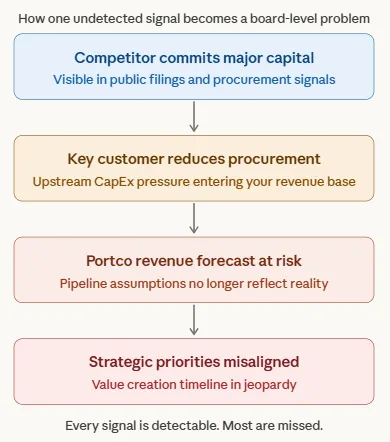
A competitor just announced a $40M plant expansion. Your portco’s largest customer is pulling back on procurement infrastructure — which touches a meaningful slice of the revenue forecast. Raw material cost inflation is quietly compressing maintenance CapEx to the point where deferred spending is becoming a balance sheet risk no one is discussing.
None of this was in the 100-day plan.
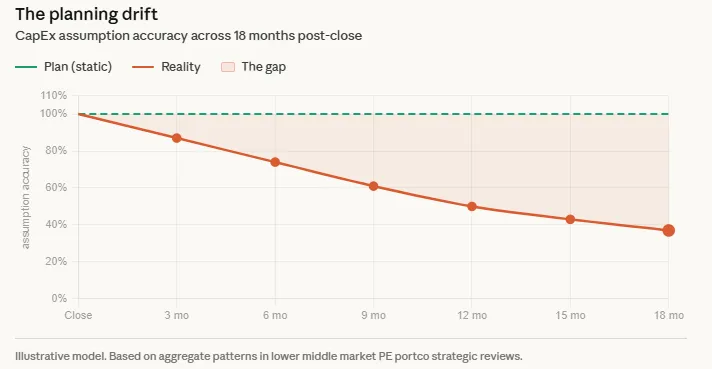
The illusion of the static capital plan: CapEx planning in most lower middle market portfolio companies is built once and revisited quarterly — if that. It reflects point-in-time assumptions about industry conditions, competitor positioning, and customer capital health. Those assumptions begin drifting from the moment the ink dries.
This creates a compounding misalignment between strategic priorities and capital reality. Resources allocate toward initiatives that made sense at close. Management attention follows the roadmap. Meanwhile, the actual terrain of opportunity and risk has shifted — and no one is holding a current map.
The cost isn’t only misallocated capital. It’s misprioritized leadership bandwidth, missed signals on customer health, and value creation timelines that slip before anyone can explain why.
“The cost isn’t only misallocated capital. It’s misprioritized leadership bandwidth, missed signals on customer health, and value creation timelines that quietly slip.”
What real-time CapEx intelligence actually enables:
Understanding how capital expenditure is moving — across your portco, its customers, its competitors, and its supply chain — is not a back-office function. It’s a strategic one.
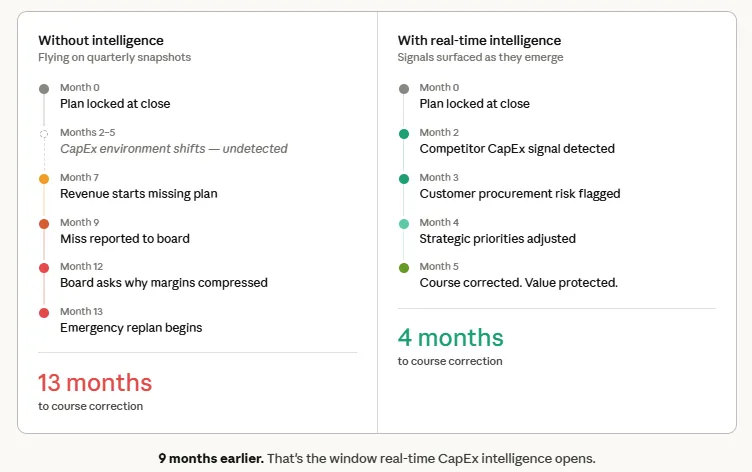
When you know a key customer is pulling back on capital investment six months before it shows up in your portco’s revenue, you can reprice, reposition, or rebuild the relationship before the damage lands. When you know a competitor is investing aggressively in a segment your portco has been deprioritizing, you can reassess whether that posture is defensible or quietly reckless. When your portco’s CapEx-to-revenue ratio is drifting outside the range of high-performing sector comps, you can make the case for course correction before the board is asking why margins are compressing.
This is the operational difference between strategic intelligence and strategic hindsight.
Why this has been hard – and why it’s changing:
The honest reason most PE firms haven’t operated this way isn’t a lack of desire. It’s a capacity problem. Building and maintaining a live intelligence layer across a portfolio — synthesizing public filings, customer procurement signals, sector CapEx benchmarks, competitive investment patterns — used to require a dedicated team, expensive data subscriptions, and significant analyst hours that most lower middle market funds simply don’t carry.
AI-driven intelligence platforms are changing that calculus materially. The synthesis work that once took weeks now happens in near real time. Signals that used to get lost in the noise surface as prioritized, actionable context. And the advisory conversation shifts from reporting what happened to framing what it means for this portfolio, at this moment in its value creation arc.
What that still requires — and what no platform replaces — is an advisory partner with the judgment to frame intelligence in the context of your specific portfolio and your specific strategic moment. The data is increasingly available. The interpretation remains a human function.
The question worth sitting with:
If your portco’s capital environment shifted materially this quarter — and it almost certainly did — how confident are you that your current strategic priorities still reflect that reality?
That gap, between what was true at the last planning cycle and what’s true now, is precisely where value creation is either protected or quietly eroded.
Recent Posts
Is The AI Analyzing Your Deals Also Exposing Them?
An examination of how AI-powered deal and portfolio tools handle confidential data during normal operation — and why the architecture of those…
The Invisible Data Problem
An examination of how the intelligence and analytics tools widely deployed across private equity portfolios handle confidential company data — and why…
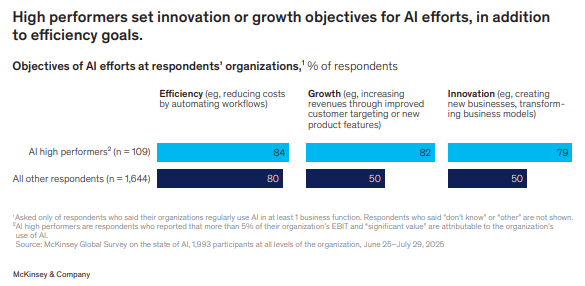
MP/GP Warning: Your LPs Don’t Care That You “Have AI.” They Care What It Changed.
LPs and boards are done funding “AI ambition.” They’re asking for proof—measurable, repeatable, auditable proof—that AI is improving the investment and execution…