In a Bifurcated Market, the Revenue Story is the Bid
This week, a look at why the deal market reopening isn’t the same opportunity for every sponsor — and what’s quietly separating the assets that transact cleanly from the ones that don’t.
3 min read
The U.S. private equity market entered 2026 with real momentum — improving financing conditions, a backlog of delayed processes, sustained demand for scaled assets. But activity grew more selective as the quarter progressed. The headline numbers look encouraging. Underneath them, something more important is happening.
The result, per this week’s Ropes & Gray market recap, is a bifurcated deal environment: high-quality assets with resilient cash flows, lender support, and a clear value-creation story can still command competitive processes. Weaker credits and harder-to-underwrite businesses face tighter structures and a smaller buyer universe.
Read that twice. Not weaker businesses — harder-to-underwrite businesses. The distinction matters enormously.
That’s a meaningful shift from the 2020-2021 environment where speed and conviction sometimes substituted for depth. It isn’t happening that way now. Buyers have options. They’re using them.
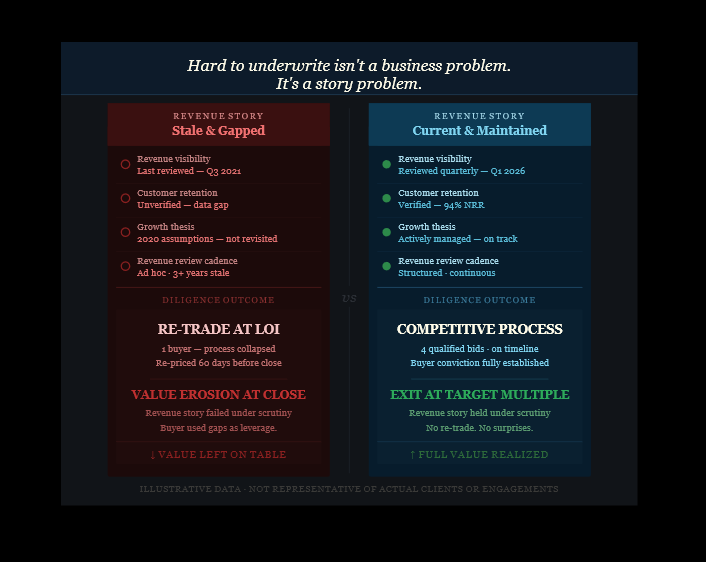
An asset is hard to underwrite when a buyer can’t get comfortable with what they’re seeing. When the revenue story has gaps. When customer concentration is higher than represented. When the growth narrative doesn’t hold up under scrutiny. When the numbers are technically accurate but the story they tell is incomplete, inconsistent, or hasn’t been actively maintained. A buyer who can’t get comfortable doesn’t just pay less — they walk, or they re-trade late in the process when the sponsor has the least leverage.
Middle market advisors noted this week that pre-COVID diligence rigor has fully returned — buyers are taking the time to understand the full picture before moving forward. That’s a meaningful shift from the 2020-2021 environment where speed and conviction sometimes substituted for depth. It isn’t happening that way now. Buyers have options. They’re using them.
There are approximately 32,500 PE-backed portfolio companies currently aging beyond their original investment horizons. Every one of those sponsors is eventually going to face a buyer’s diligence team asking the same questions: Where is the revenue coming from? How sticky is it? What’s the real retention story? What happened to the growth thesis from the acquisition memo?
The sponsors who answer those questions cleanly — not because they prepared for the question, but because they’ve been actively managing the answer — are the ones commanding competitive processes right now. The ones who haven’t are discovering what “hard to underwrite” costs them at the worst possible moment.
McKinsey’s 2026 Global Private Markets Report put it plainly: the prevailing cycle is defined by strong execution and capital structure discipline. The tailwinds that carried the last cycle are gone. In a market where multiple expansion is no longer doing the work, the revenue story isn’t a supporting exhibit in the data room. It’s the bid.
Recent Posts

Is The AI Analyzing Your Deals Also Exposing Them?
An examination of how AI-powered deal and portfolio tools handle confidential data during normal operation — and why the architecture of those…

The Invisible Data Problem
An examination of how the intelligence and analytics tools widely deployed across private equity portfolios handle confidential company data — and why…
MP/GP Warning: Your LPs Don’t Care That You “Have AI.” They Care What It Changed.
LPs and boards are done funding “AI ambition.” They’re asking for proof—measurable, repeatable, auditable proof—that AI is improving the investment and execution…