The Portfolio Blind Spot Problem
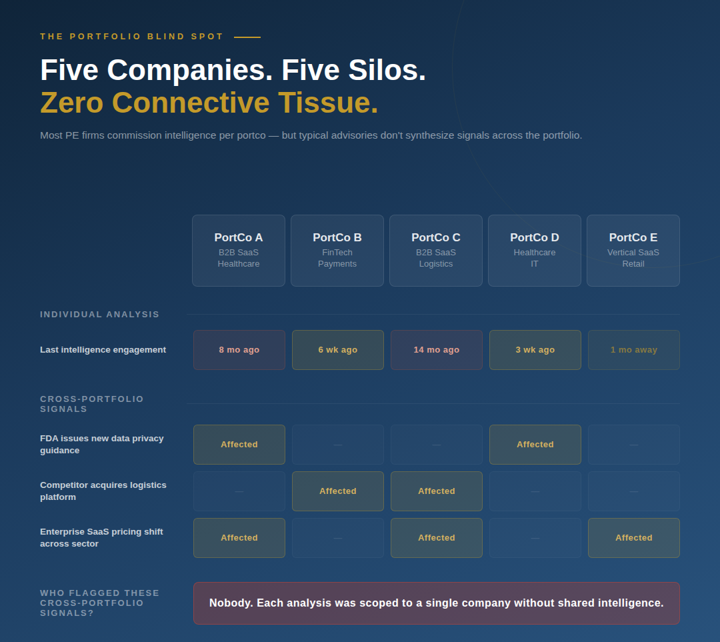
Last week we explored The Staleness Problem — why traditional strategic analyses are often outdated by the time they’re delivered. This week we’re looking at a different gap, one that can persist even when the intelligence is fresh.
Imagine a mid-market PE firm with five portfolio companies across B2B SaaS, fintech, healthcare IT, and vertical software. Each company has had some form of strategic analysis performed by a typical advisory — commercial due diligence at acquisition, an operational assessment six months in, maybe a competitive landscape refresh when a board member raised a concern.
This advisory conducted its work with each analysis scoped to each individual company. Each was delivered as a standalone report. Each sits in its own deal folder.
Now consider what happens when the FDA issues new data privacy guidance. It directly affects the healthcare IT portco — but it also has implications for the B2B SaaS company selling into healthcare systems. Two portfolio companies. One regulatory signal. Who connected the dots?
Nobody. Because no one at this advisory was watching the spaces between portfolio companies.
The Staleness Problem we discussed last week is about the decay of intelligence over time within a single engagement. The Portfolio Blind Spot Problem is different — it’s about the absence of connected intelligence that a typical advisory never produces in the first place.
The Silos are Hurting You
This isn’t a failure of diligence or intelligence itself. The problem is that the intelligence is structurally siloed — each analysis is scoped to one company, performed by one consultant (or one isolated team within a firm), delivered at one point in time, and never systematically connected to anything else in the portfolio.
The result is a collection of isolated snapshots where there should be a comprehensive collage.
When a competitor of PortCo B acquires a logistics platform, that’s relevant intelligence for PortCo C, which operates in logistics SaaS. When enterprise SaaS pricing models shift industry-wide, that signal has implications for three companies in the portfolio simultaneously. When a talent market tightens in a specific geography, it affects every portco hiring in that region.
How This Compounds
The Staleness Problem we discussed last week is about the decay of intelligence over time within a single engagement. The Portfolio Blind Spot Problem is different — it’s about the absence of connected intelligence that a typical advisory never produces in the first place. Even if every individual analysis were perfectly current, the cross-portfolio synthesis layer would still be missing.
This matters because PE firms don’t manage risk at the portco level alone. A regulatory shift that affects two companies in the same portfolio has a different risk profile than one that affects a single company. A competitive signal that’s relevant across three portcos isn’t three separate insights — it’s a portfolio-level strategic consideration that should inform capital allocation, operational priorities, and exit timing.
But the traditional consulting model has no mechanism for this. Each engagement is scoped, executed, and delivered in isolation. The consultant analyzing PortCo A has no visibility into what was found during the PortCo D assessment. The firm that produced the competitive landscape for one company doesn’t know that a finding in that landscape has direct relevance to another company three deal folders away.
What Cross-Portfolio Intelligence Requires
Closing this gap requires a persistent intelligence layer that operates across the portfolio — one that ingests signals from the market, maps them against the strategic context of every portfolio company, and surfaces cross-cutting implications that no single-company analysis would ever catch.
The technology to do this exists today. The question is whether firms recognize that the blind spot exists — and that it can’t be solved by doing more of what they’re already doing.
Recent Posts
Is The AI Analyzing Your Deals Also Exposing Them?
An examination of how AI-powered deal and portfolio tools handle confidential data during normal operation — and why the architecture of those…
The Invisible Data Problem
An examination of how the intelligence and analytics tools widely deployed across private equity portfolios handle confidential company data — and why…
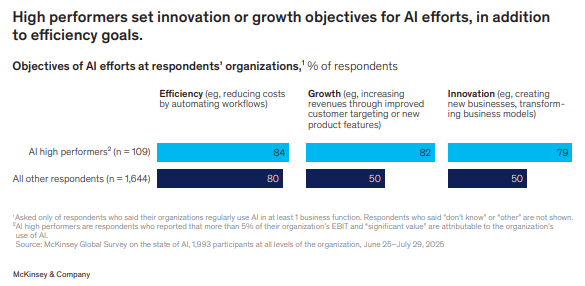
MP/GP Warning: Your LPs Don’t Care That You “Have AI.” They Care What It Changed.
LPs and boards are done funding “AI ambition.” They’re asking for proof—measurable, repeatable, auditable proof—that AI is improving the investment and execution…