The Exit Math Has Changed. Has Your Investment Thesis?
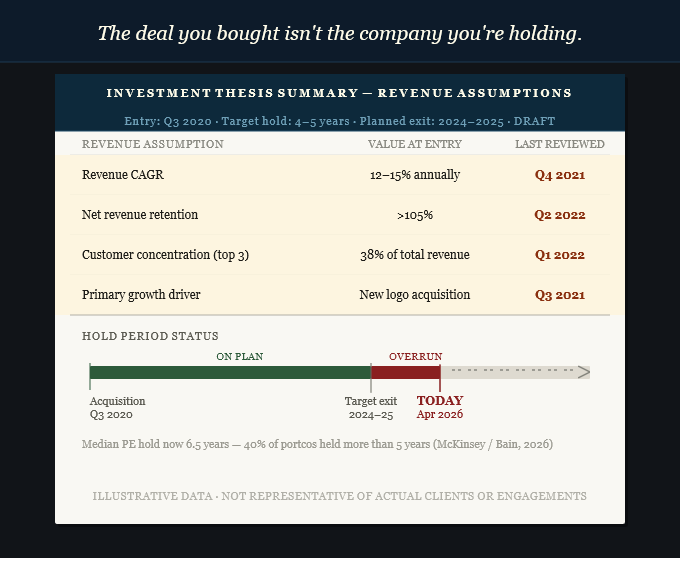
There is a number sitting in this week’s McKinsey Global Private Markets Report that should give every lower middle market GP a moment’s pause: the average hold period for a PE-backed company is now six and a half years. More than half of all buyout-backed inventory globally has been held for over four years. The Bain data is equally stark — nearly 40% of all portfolio companies have been held more than five years, up from 29% in 2019.
None of that is news to the GPs living it. What is worth sitting with, though, is what it means for the revenue story.
When a company was acquired four, five, six years ago, the investment thesis was built around a specific view of that company’s revenue: who the customers were, why they stayed, where growth would come from, and what the ceiling looked like. That thesis was underwritten at a particular moment in time, in a particular macro environment, against a particular competitive landscape.
That moment no longer exists.
When a company was acquired four, five, six years ago, the investment thesis… was underwritten at a particular moment in time, in a particular macro environment, against a particular competitive landscape.
That moment no longer exists.
The customers have changed. The pricing dynamics have shifted. The sales motion that worked in 2020 or 2021 may have quietly eroded. New competitors have entered. Old ones have gotten sharper. And in the current environment — with tariff pressure reshaping cost structures, customer purchasing decisions being delayed, and demand signals flickering across every sector — the revenue story a GP could tell with confidence eighteen months ago deserves serious reexamination before it becomes the story they tell a buyer.
Here is what makes this particularly acute: Bain’s data on why deals failed to close in 2025 puts poor earnings quality and customer churn among the top diligence red flags cited by buyers. Not valuation gaps. Not structure. Revenue quality. Which means the companies struggling to exit aren’t just the ones with bad numbers — they’re the ones whose revenue story didn’t hold up to scrutiny when it mattered most.
Longer holds don’t have to mean weaker exits. But the gap between a clean exit and a difficult one is increasingly being decided not at the negotiating table — but in the revenue story a buyer finds when they start asking questions.
The market doesn’t care when you planned to leave. It cares about how you’re best prepared for ensuring your plan aligns with real-time conditions.
Recent Posts

Is The AI Analyzing Your Deals Also Exposing Them?
An examination of how AI-powered deal and portfolio tools handle confidential data during normal operation — and why the architecture of those…

The Invisible Data Problem
An examination of how the intelligence and analytics tools widely deployed across private equity portfolios handle confidential company data — and why…
MP/GP Warning: Your LPs Don’t Care That You “Have AI.” They Care What It Changed.
LPs and boards are done funding “AI ambition.” They’re asking for proof—measurable, repeatable, auditable proof—that AI is improving the investment and execution…